Why Shiplet
Why each review link gets its own interface and durable root.
Every Shiplet gets a root
Shiplet turns anything you can open in a browser into a review link.
The artifact is the thing under review: a website, prototype, document, or report. Shiplet gives that artifact one link where reviewers can click directly on the work and leave comments in context. When they return, the conversation is waiting in the same place.
The review widget is the toolbar and panel around the artifact. A team can customize it for the work in front of them, and the artifact itself stays unchanged. I want that widget to make every Shiplet feel like its own little product.
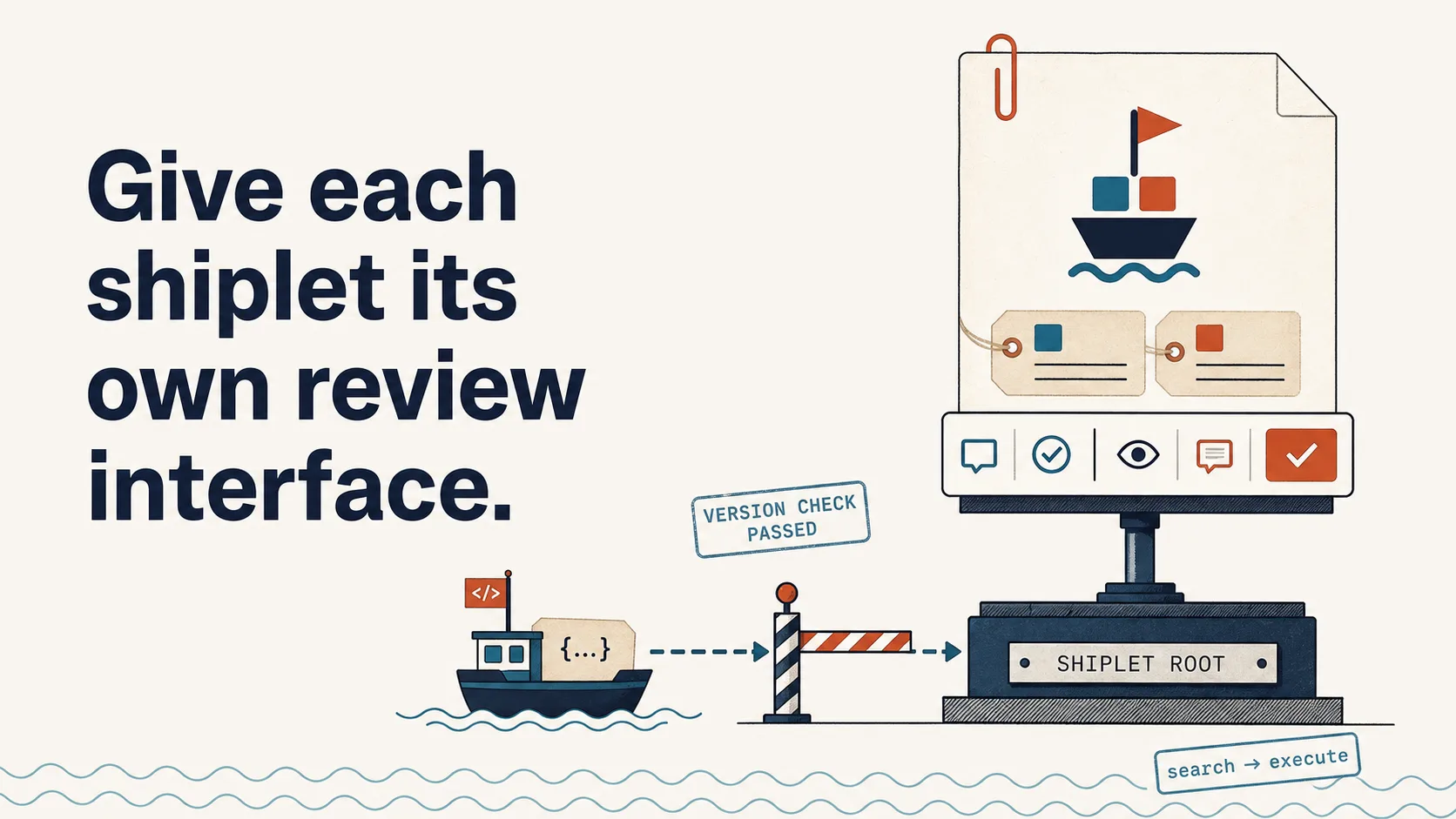
On a working build, a PM cares about whether each acceptance criterion survives the awkward states. A researcher's prototype carries a different question, because every product claim needs a path back to the observations behind it. The review layer holds that context because it belongs to the work.
Each link is its own review room, so every Shiplet gets a root.
The root remembers which widget the Shiplet uses and keeps its feedback together. It also coordinates who is in the live room.
Cloudflare Durable Objects give that root a permanent address and storage of its own. One Durable Object belongs to one Shiplet, so every request for that review returns to the same place.
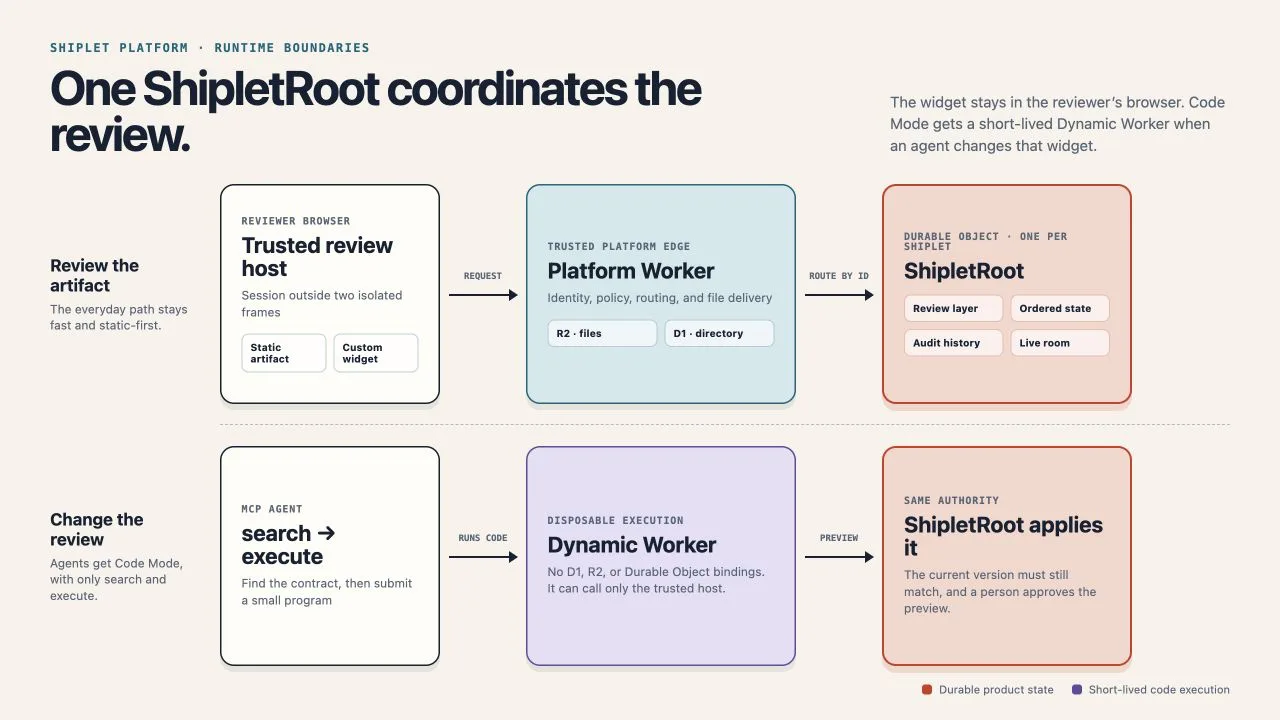
The review belongs to the Shiplet
A Shiplet is the review room around one artifact. Its widget belongs to that room.
The default experience stays small. A trusted host renders the artifact inside an isolated frame, adds the review toolbar, and keeps the reviewer's session outside the artifact. Pins stay attached to the context people were looking at, and comments return to the same review link.
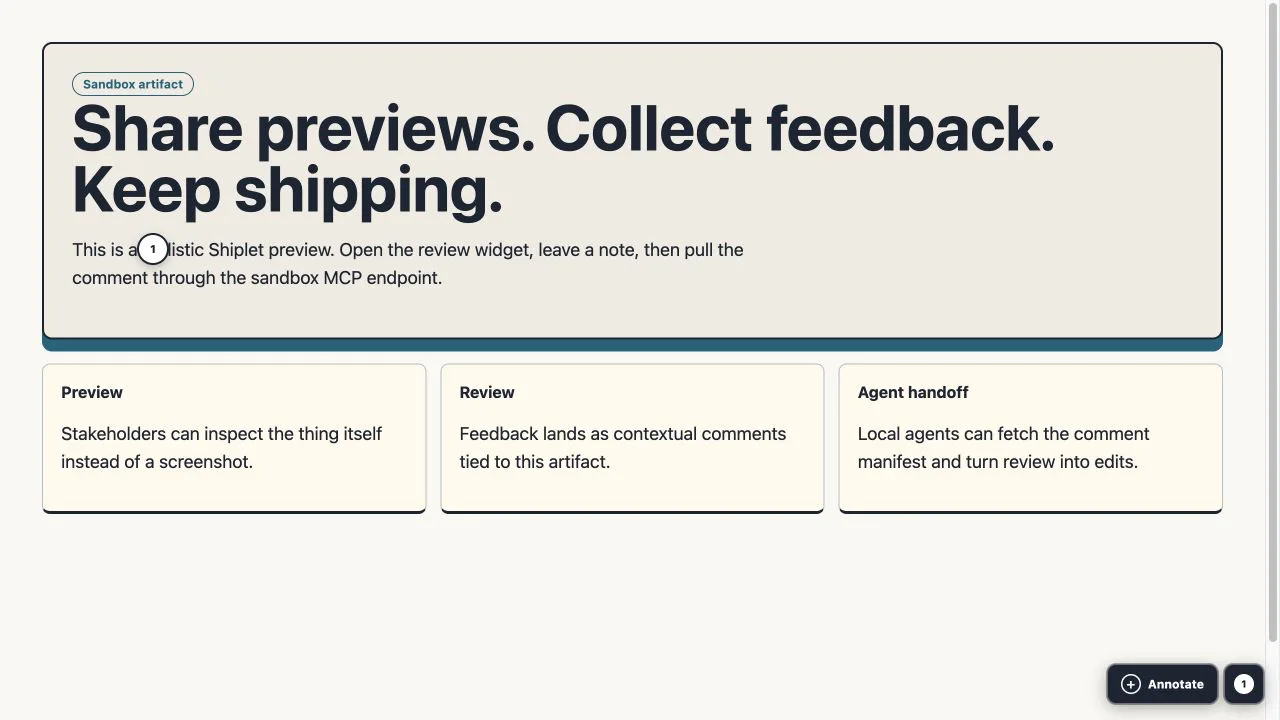
The ShipletRoot owns the layer around that artifact. It knows which widget is active, which changes are waiting in preview, where the current layer came from, and who is in the live room. That gives us room to make a review feel purpose-built without changing the files underneath it.
The widget itself is browser code. Shiplet runs the approved widget in its own sandboxed frame, where it can render controls and react to the reviewer. It never receives the user's session or direct bindings to D1 and R2. The Durable Object stays outside that frame too. When the widget needs to create feedback or record a workflow event, it asks the trusted host through a small, typed operation.
That boundary lets deep customization become a normal product feature with explicit authority.
The interface can speak the language of the work
The review toolbar should care about the job in front of it.
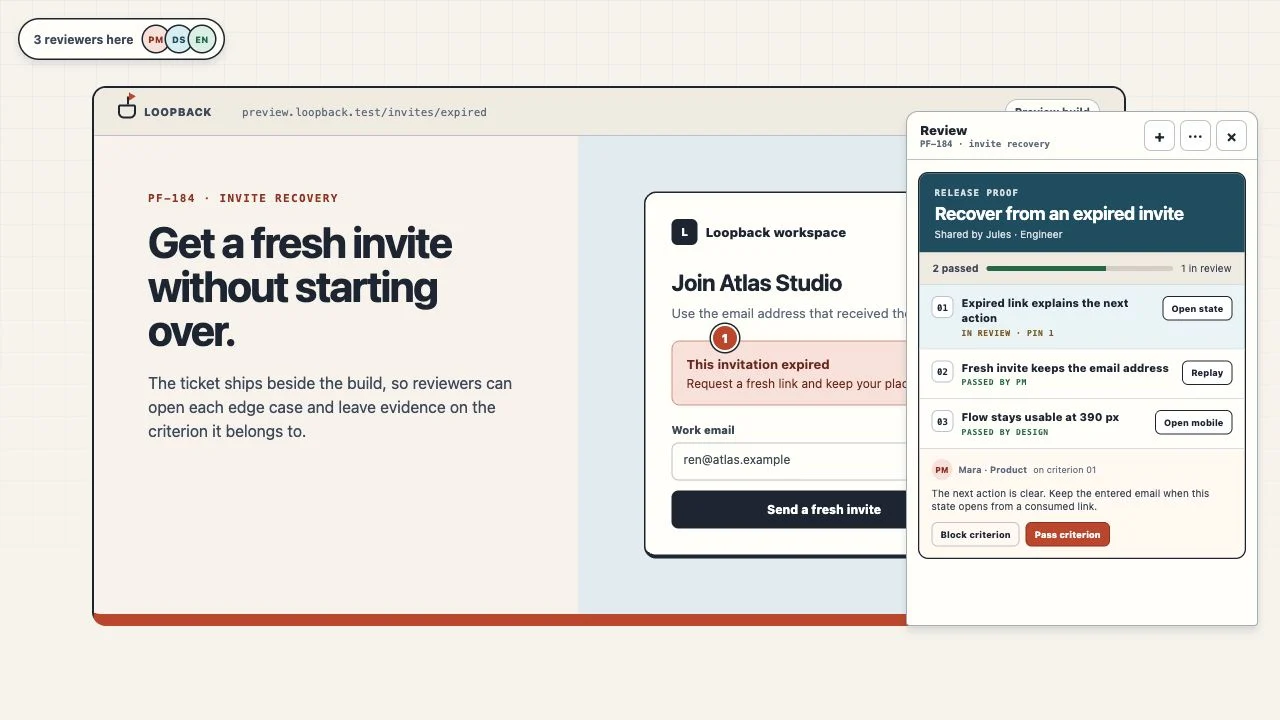
A widget can turn a ticket's acceptance criteria into the controls that prove them. When an engineer shares a build for invite recovery, each criterion can open the exact state it names. The PM can pass or block that criterion, and the designer can inspect the mobile state without reconstructing the ticket from memory.
A research readout needs a different shape. The researcher places the current product claim beside the observations behind it. The evidence board lets a PM mark an observation as support for the claim, and contradictory evidence stays visible beside that support. A designer can flag the assumption that still needs testing without losing the prototype underneath.
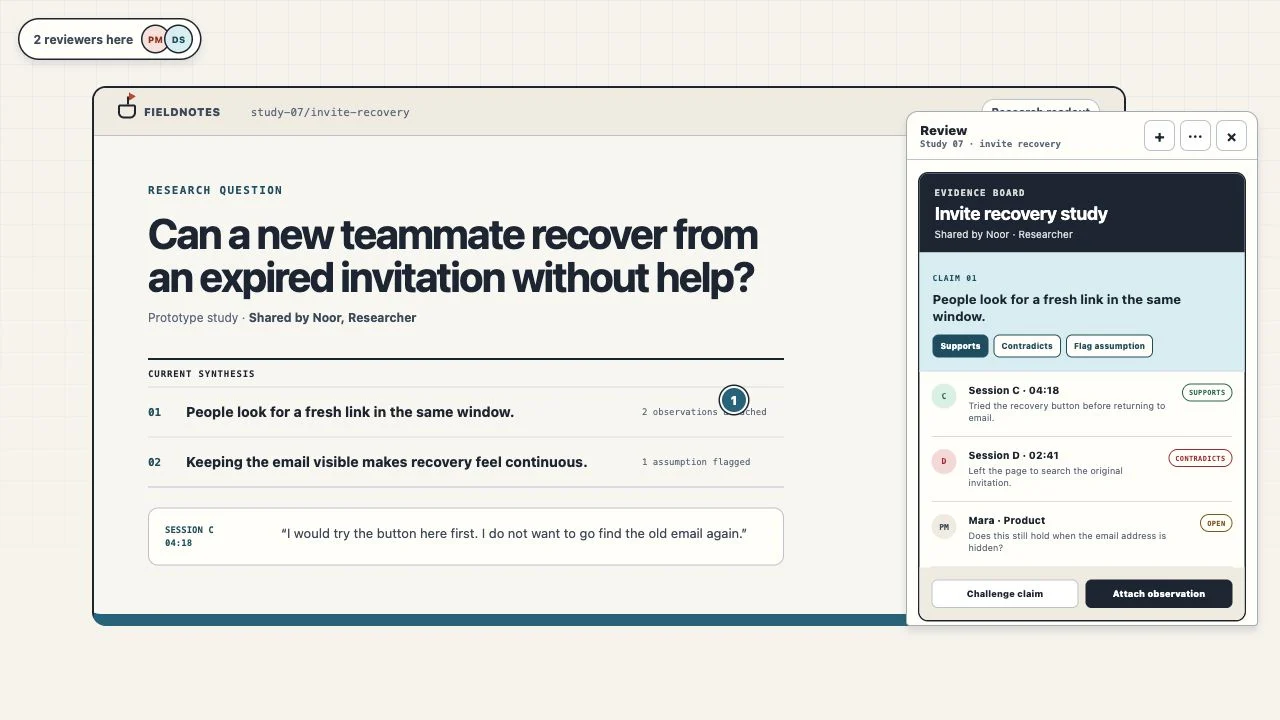
These widgets were applied through the review-layer contract used by the product. Shiplet prepared each change as a preview, compiled the layer inside its sandbox constraints, and applied it only after the root confirmed that the base version still matched.
Code Mode keeps the power behind a narrow door
An agent can customize the review layer through Shiplet's MCP. It sees two tools: search and execute.
search lets the agent find the relevant contract without dumping the whole platform into context. execute accepts a small program, and Shiplet runs that program in a disposable Dynamic Worker. The Worker gets no direct D1, R2, or Durable Object bindings. It can reach only the operations exposed by the trusted host.
The program can read the current review layer and prepare a bounded set of file changes. The result is a preview attached to the root's current version. A person can open that preview, use the proposed widget, and approve it. The root applies the change with a version check, so a stale agent turn cannot overwrite something newer.
The approved widget then runs where the reviewer uses it: inside the browser sandbox. The Dynamic Worker has finished its short job by that point.
Code Mode handles programmable authoring before the browser runs the interface. ShipletRoot remains the authority that makes a change real.
Durable Objects make the product easier to engineer
I care about the engineering shape because it lets product benefits keep accumulating inside one clear coordination boundary.
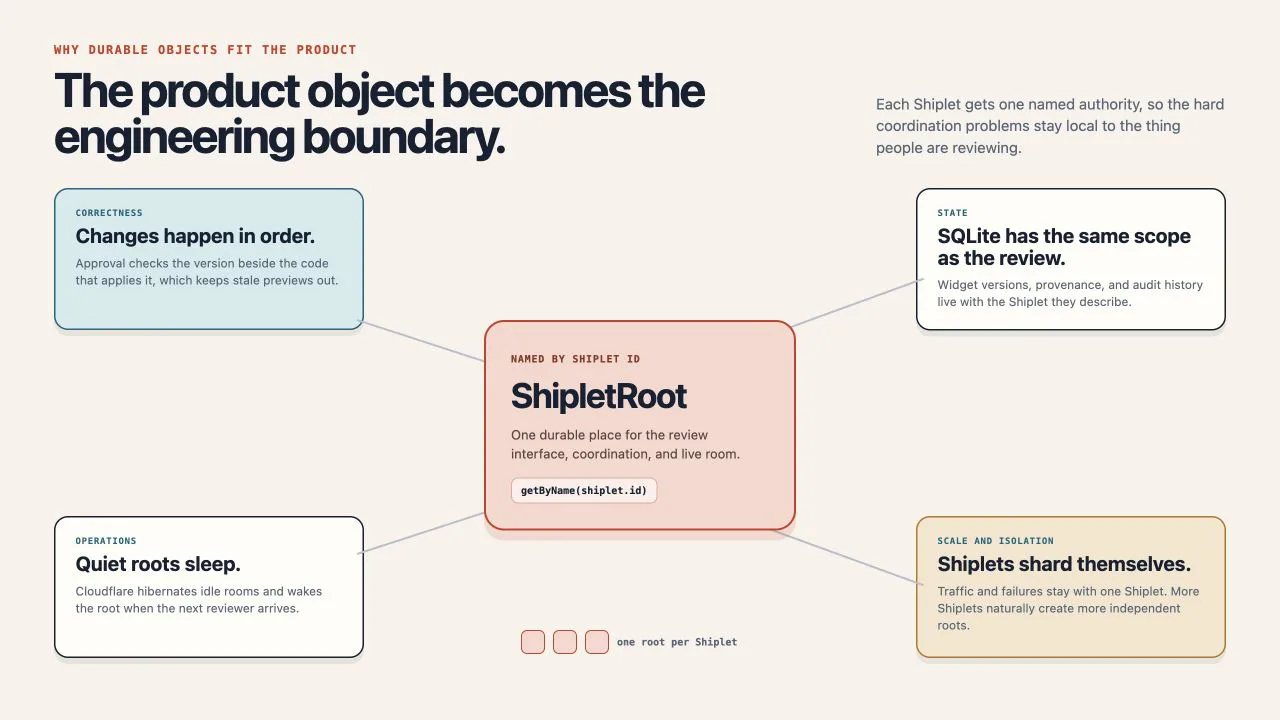
One name gives us one authority
The Platform Worker resolves the root with getByName(shiplet.id). Requests for the same Shiplet reach the same logical object, which already has the current review-layer version beside the code that changes it.
Applying a preview is a guarded update inside that object. If the root has moved past the preview's base version, the update fails closed. The guarded update replaces a separate lock service for deciding which review layer won.
SQLite has the right scope
Each root gets its own SQLite-backed storage. The active layer, pending previews, provenance, and audit events live with the Shiplet they describe.
That local scope makes the data model easier to reason about. A migration belongs to one product object, and an incident has a local timeline. The root reads the current layer directly from its own durable state, with no global projection in the request path.
Quiet review rooms can sleep
ShipletRoot also owns presence for its review link. Cloudflare's WebSocket Hibernation API can keep reviewers connected at the network while an idle object leaves memory, then wake the root when a new message arrives.
The live-room abstraction survives that sleep cycle because durable state was already written beside the root. Cloudflare keeps idle connections at the network, which cuts the application time spent keeping quiet review rooms awake.
Shiplets shard themselves
More Shiplets create more roots. Traffic for one review stays with that review, and a broken customization stays inside its browser frame and Shiplet boundary. Other Shiplets keep moving through their own roots.
One unusually hot Shiplet still has the throughput ceiling of one root. That is an honest limit and a useful one for the product we have. If a future Shiplet turns into a stadium, we can add fan-out behind its stable root identity.
Inheritance copies the useful part
Once a team has a review setup that works, the next Shiplet can inherit it.
Inheritance takes a snapshot of the source review layer and records its provenance. The child receives its own root and its own version, so changes stay local. A later update to the source can arrive as another preview, where somebody can inspect it before the child changes.
An organization can maintain a house review layer. A team can adapt that layer for its workflow, and a specific Shiplet can take the interface somewhere more specialized. Each step remains a usable review experience with a visible origin.
The snapshot matters because review interfaces can encode real process. A distant template edit has to pass review before it can add a required approval or rename a status in the middle of somebody's work.
Software should be allowed to wander
I keep thinking about what it means for software to belong to the people using it. An organization should be able to choose where Shiplet lives: on Shiplet Cloud or in its own Cloudflare account. Moving between those homes should feel ordinary.
Once it is there, local coding agents should be able to reshape it until it fits the organization, while a path back to upstream improvements remains open. I care about that shape before I care about the neat open-source category for it.
Git can move source between developers. Software with live state and local mutations carries a different kind of history. There is something else hiding in that gap. I do not have the name for it yet.
The rest of the stack can stay boring
The Platform Worker handles identity, policy, routing, and file delivery. R2 holds immutable artifact bytes. D1 powers the organization directory and views that cross many Shiplets. The root keeps the state that needs agreement inside one Shiplet.
Most artifacts remain static, which keeps publishing fast and gives the thing being reviewed a tiny runtime. A custom review layer leaves the artifact on that path. When an artifact needs its own backend behavior, Workers for Platforms gives Shiplet an advanced path with a separate security burden.
Those boundaries also give the product somewhere clean to grow:
- Approval stages can live beside the review-layer version they control.
- Subscriptions can listen to the root's ordered events.
- An automation can wake for one Shiplet and produce another reviewable preview.
If we add an agent that stays with a Shiplet, the root already gives it a bounded checkpoint connected to an ordered event stream. A capability boundary controls what the agent can do when it wakes for an approved event. The agent works in a sandbox and writes its result back as another preview, keeping the existing identity system and global coordination boundary.
Each Shiplet can grow into exactly the review room its artifact needs, while the platform stays legible.
Try the review layer
Prepare your first review artifact, then open the review link and leave a comment on the work itself.